
ZenGrove
Built to move. Down to the last leaf.
Built to move. Down to the last leaf.
The ZenGrove 1.0.0 reference: 52 nodes, 907 settings and short WebM demos. Explore Look At asset orientation, GameDynamics, joint previews, skeletal export and per-leaf random vertex colors. Requires AO.Hub 1.6.6 or later.
Twigs
Adds smaller branches to the current branch layer. Use its size profiles to vary twig size from the base toward the tips.
Branches
Branches
Count requests children or sites per parent. Opposite creates two children per site; Whorled creates Whorl Count children per site. Spacing instead measures distance along the physical parent curve. Minimum Site Distance skips crowded sites as complete pairs or whorls, so the final count can decrease.
Distribution Profile redistributes Count without thinning it. Length Profile changes length; Scale Profile changes length and radius. Pattern Rotation turns the full arrangement, while Rotate Pattern turns successive sites. Up Influence remains world-up and Shape Sag world-down. Opposite’s Up / Down adds world elevation to both children: +10° lifts a flat pair to a 160° opening above.
Surface Attachment starts the branch on the actual parent surface and fits a collar using existing mesh rings. It is on for new Branch nodes and off for new Twigs; saved choices are preserved. Transition Length, Spread and Upper / Lower Spread shape the footprint. Increase Resolution for a smoother collar; adding branches does not insert extra support rings into the parent.
Watch the Twigs settings tour
Current Maya controls, including conditional settings. Each view stays on screen for one second (three views take three seconds); pause or choose a group to inspect it.
Generation
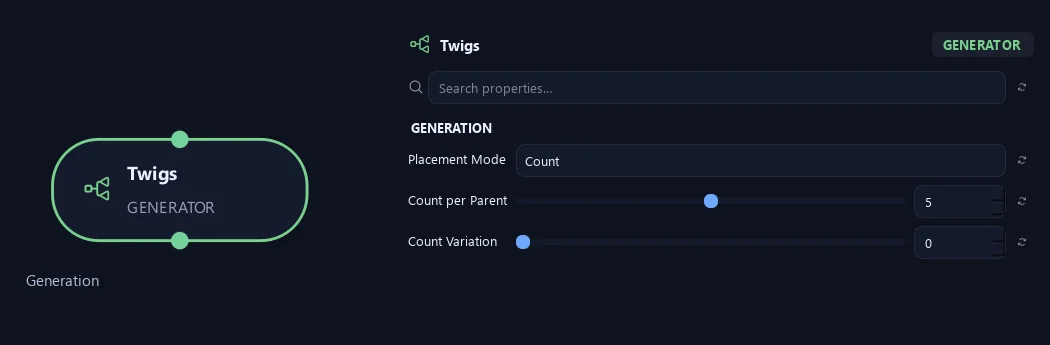
- Placement Mode
Count chooses how many attachment sites or children to request; Spacing sets their distance along the parent in scene units. The panel shows the controls for the selected mode.
- Count per Parent
Sets new growth per parent. Random, Parallel and Alternating count individual children. Opposite counts sites with two children each; Whorled counts sites with Whorl Count children each. Count 8 and Whorl Count 3 produce 24 children before any split-range allocation.
Available when Placement Mode is Count.
- Count Variation
Adds seeded variation to Count per Parent, from minus to plus this amount, with a minimum result of zero. Opposite varies pairs and Whorled varies whorls. Existing Split allocation still applies.
Available when Placement Mode is Count.
Distribution (1)
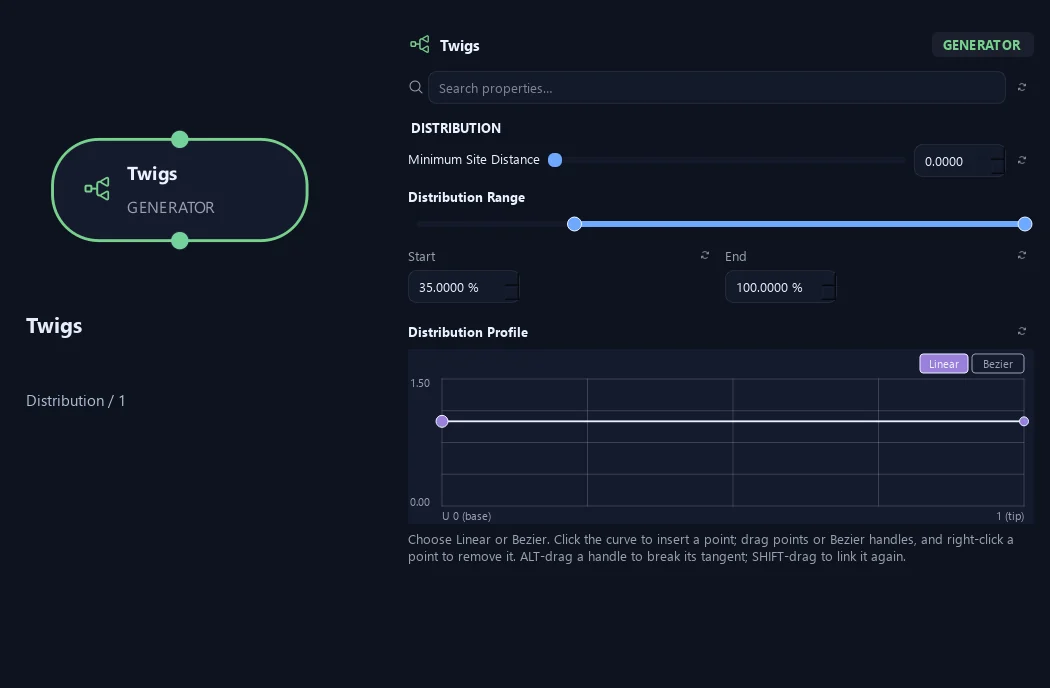
- Minimum Site Distance
Minimum arc-length distance between sites. Crowded sites are skipped as whole pairs/whorls; final count may be lower.
- Distribution Range — Start %
Sets where placement begins on the parent. Zero is the base and one is the tip; the range slider displays percentages.
- Distribution Range — End %
Sets where placement ends. Together with Start, this defines the Distribution Range.
- Distribution Profile
Sets relative spawn density along the parent, from base (0) to tip (1), within Start/End. Higher regions attract more attachment sites without changing the chosen count or breaking pairs and whorls. Flat and all-zero profiles keep the ordinary placement.
Available when Placement Mode is Count.
Distribution (2)
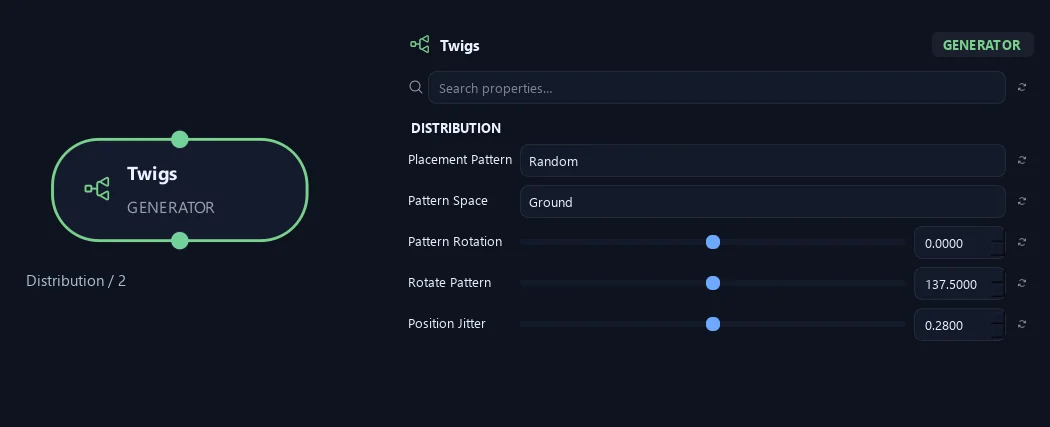
- Placement Pattern
Random distributes freely. Parallel pairs a total child count. Alternating switches sides along the parent. Opposite creates two children per site. Whorled creates a ring of children per site.
- Pattern Space
Ground aligns the pattern to the horizontal world plane. Parent turns it with the branch. Opposite and Whorled always follow the parent.
Available when Placement Pattern is Random or Parallel or Alternating.
- Pattern Rotation
Rotate the arrangement around each current local parent tangent before world-space Up / Down, Up Influence and Shape Sag. Rotate Pattern controls successive sites.
- Rotate Pattern
Rotates each successive site around the parent. With Opposite, zero aligns pairs and 90 degrees crosses each pair over the previous one.
- Position Jitter
Loosens spacing along the parent while keeping paired sites together.
Orientation
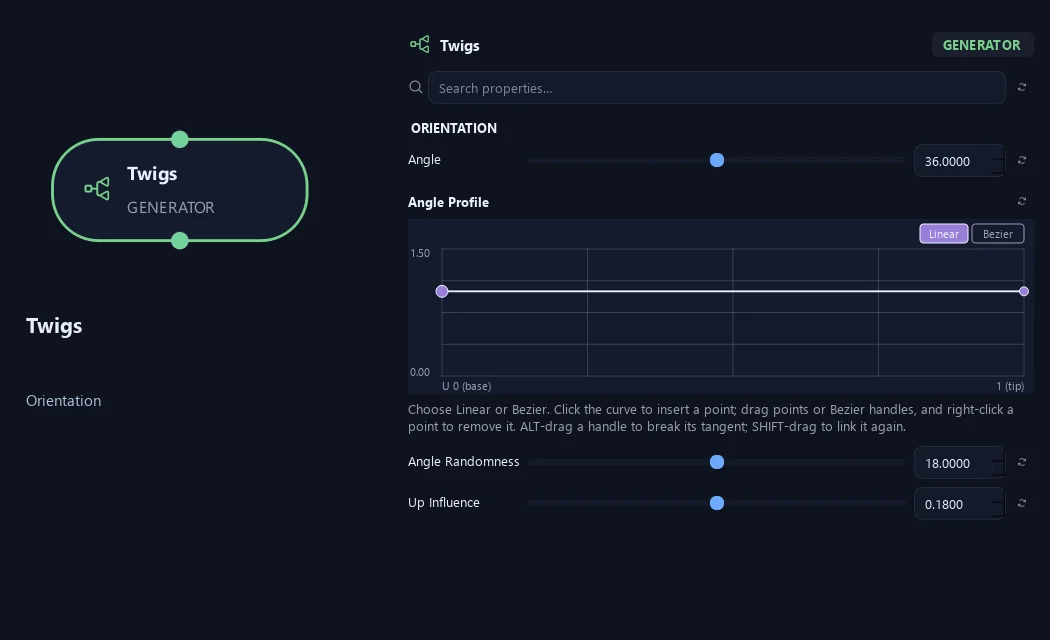
- Angle
Sets the angle away from the parent direction. Small values follow it; larger values open the growth outward.
- Angle Profile
Multiplies Angle by attachment position on the parent: left is base and right is tip. One keeps the angle, lower values close it and higher values open it.
- Angle Randomness
Varies the angle between branches or leaves. Zero keeps it consistent.
- Up Influence
Bias growth toward world +Y, independent of Pattern Rotation. Negative values bias toward -Y. Surface attachments bend along the path; embedded attachments adjust the initial growth direction.
Shape (1)
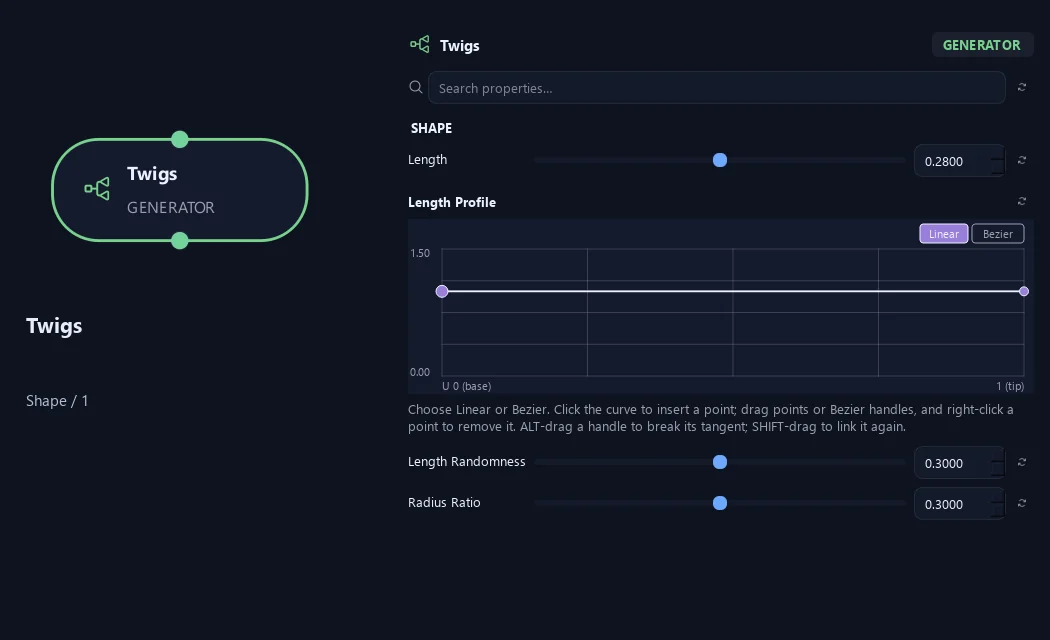
- Length
Sets child length relative to parent length. For example, 0.5 starts at half the parent length, before profiles and randomness.
- Length Profile
Multiplies child length by its attachment position. Left is the parent base and right is its tip. One keeps Length; 0.5 halves it.
- Length Randomness
Varies length between branches. Zero keeps lengths consistent.
- Radius Ratio
Sets child base radius relative to parent radius at the attachment.
Shape (2)
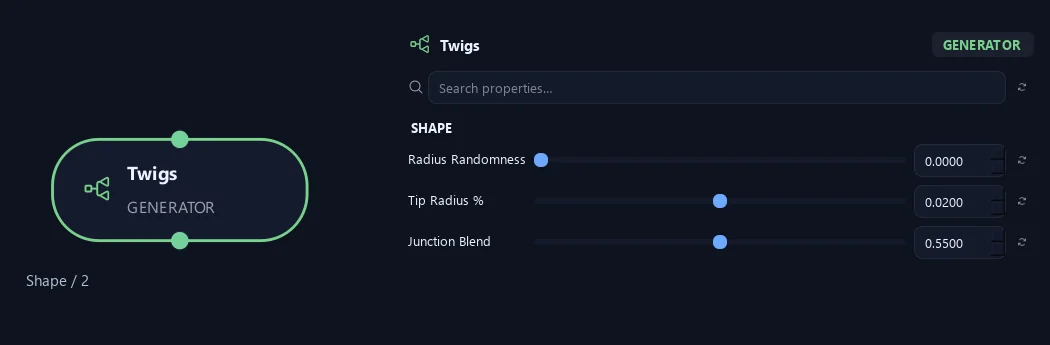
- Radius Randomness
Independent per-child radius variation. Does not change length, angle or placement.
- Tip Radius %
Sets tip radius as a fraction of child base radius. For example, 0.08 leaves 8% at the tip.
- Junction Blend
Softens the change in direction and thickness at the parent connection. Zero makes a harder junction.
Deformation
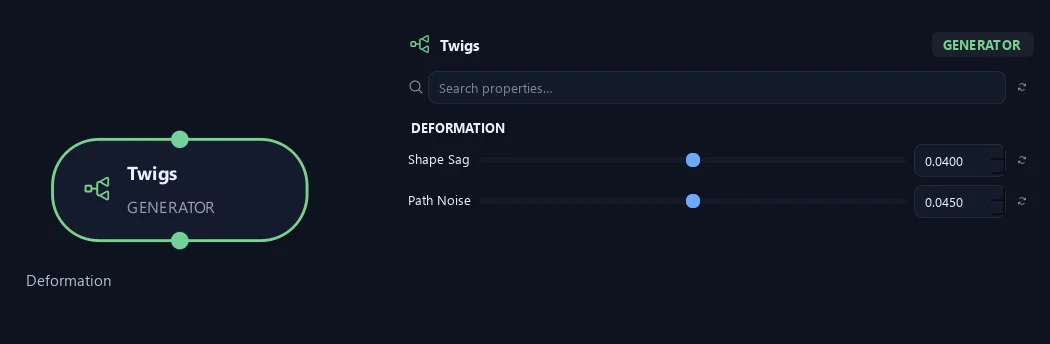
- Shape Sag
Quadratic shape offset toward world -Y during child construction, independent of Pattern Rotation. Negative values lift toward +Y. Does not contribute a growth Force.
- Path Noise
Adds small irregular bends to the generated path.
Scale
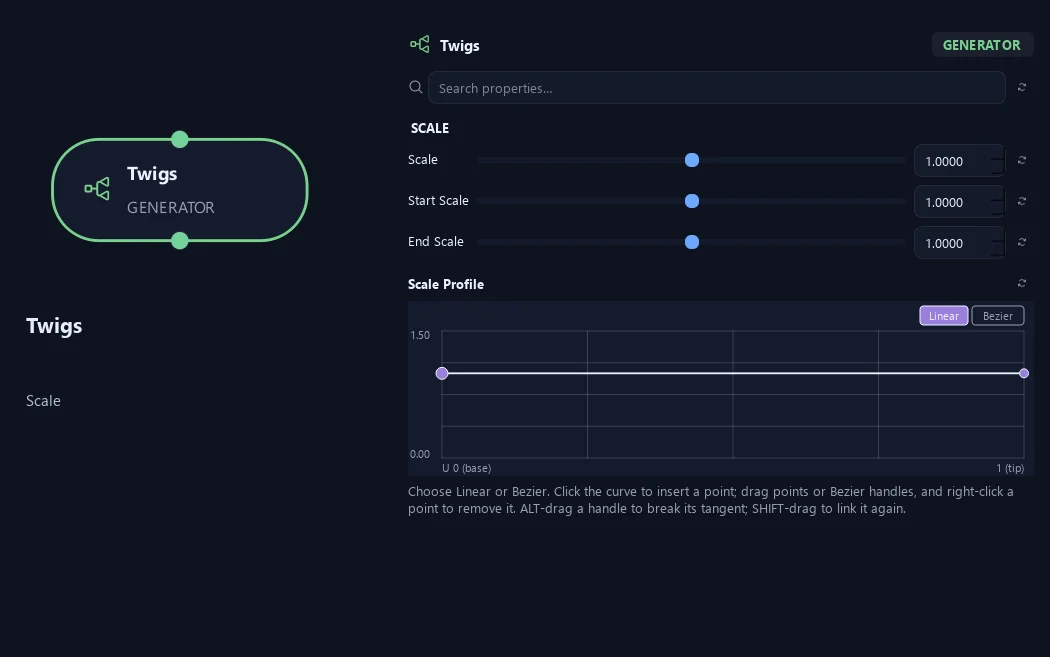
- Scale
Scales the asset or generated child uniformly. One keeps its size; 0.5 halves it.
- Start Scale
Scales twig length and thickness at the start of the placement range.
- End Scale
Scales twig length and thickness at the end of the range, blending from Start Scale.
- Scale Profile
Multiplies child length and radius at each attachment position along the parent. It combines with Scale and, for Twigs, Start/End Scale. A flat value of 1 preserves those settings. Length Profile separately affects length; geometry safety minima still apply.
Geometry
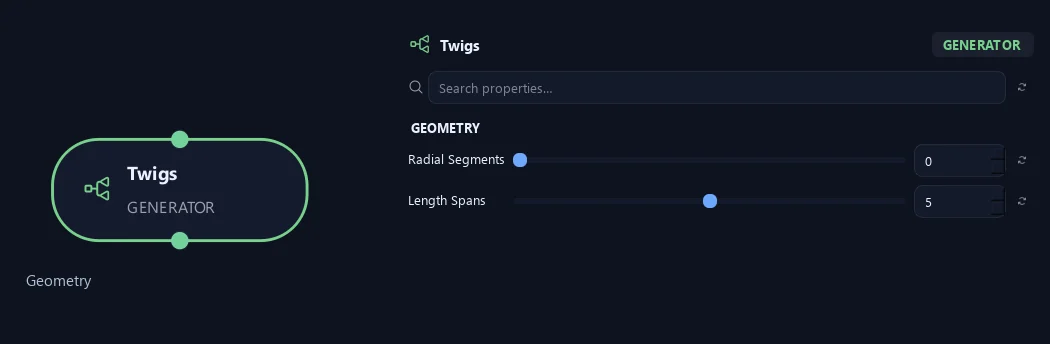
- Radial Segments
Sets sides around the branch tube. More sides look rounder. Where zero is available, it inherits Output.
- Length Spans
Number of centerline spans along each generated branch. Ordinary attachments reuse these rings and do not add support loops to their parent.
Advanced
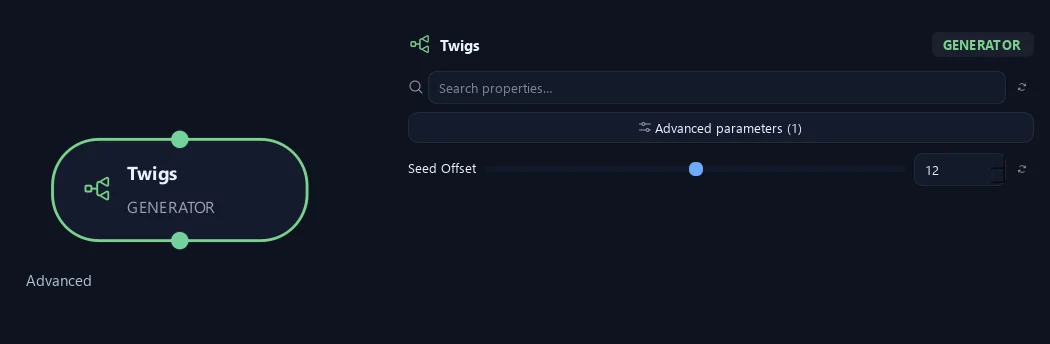
- Seed Offset
Changes this node's random variation. Keep the seed and settings unchanged to reproduce the same result.
Branch Attachment
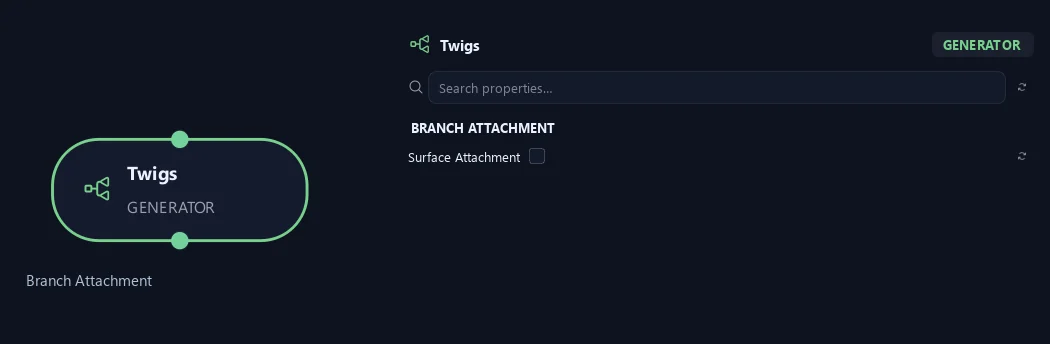
- Surface Attachment
Grow from the chosen parent surface position and fit the collar to its mesh using the existing Resolution rings.
Generation
Shown example: Placement Mode = Spacing.
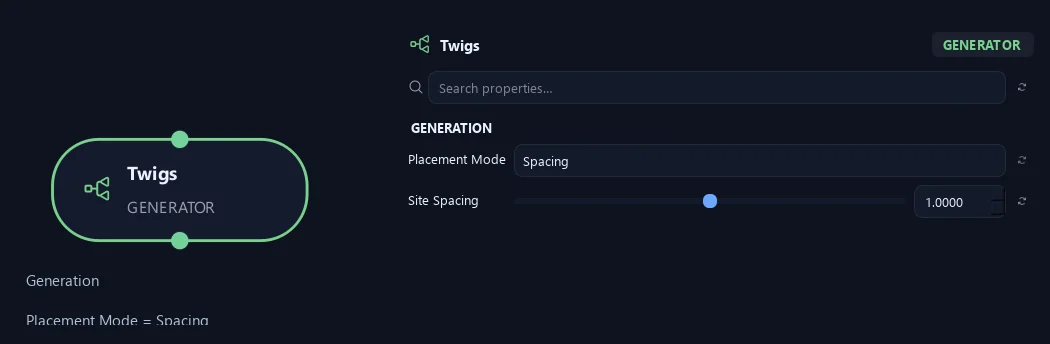
- Placement Mode
Count chooses how many attachment sites or children to request; Spacing sets their distance along the parent in scene units. The panel shows the controls for the selected mode.
- Site Spacing
Distance between attachment sites in scene units. Position Jitter varies sites; pairs and whorls remain together.
Available when Placement Mode is Spacing.
Distribution (1)
Shown example: Placement Pattern = Whorled.
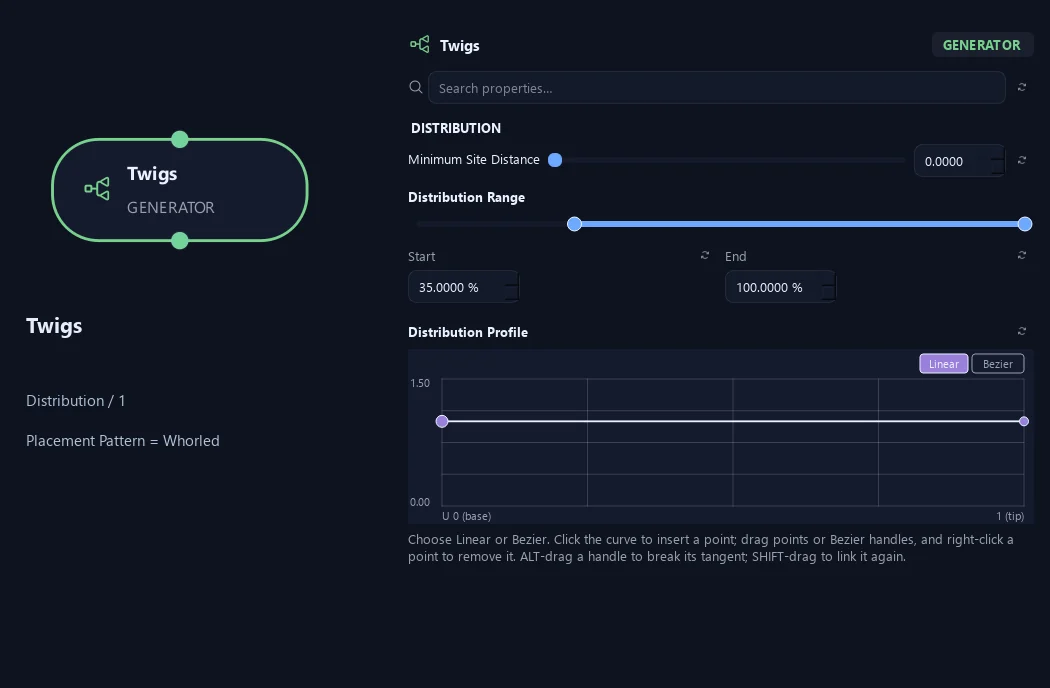
- Minimum Site Distance
Minimum arc-length distance between sites. Crowded sites are skipped as whole pairs/whorls; final count may be lower.
- Distribution Range — Start %
Sets where placement begins on the parent. Zero is the base and one is the tip; the range slider displays percentages.
- Distribution Range — End %
Sets where placement ends. Together with Start, this defines the Distribution Range.
- Distribution Profile
Sets relative spawn density along the parent, from base (0) to tip (1), within Start/End. Higher regions attract more attachment sites without changing the chosen count or breaking pairs and whorls. Flat and all-zero profiles keep the ordinary placement.
Available when Placement Mode is Count.
Distribution (2)
Shown example: Placement Pattern = Whorled.
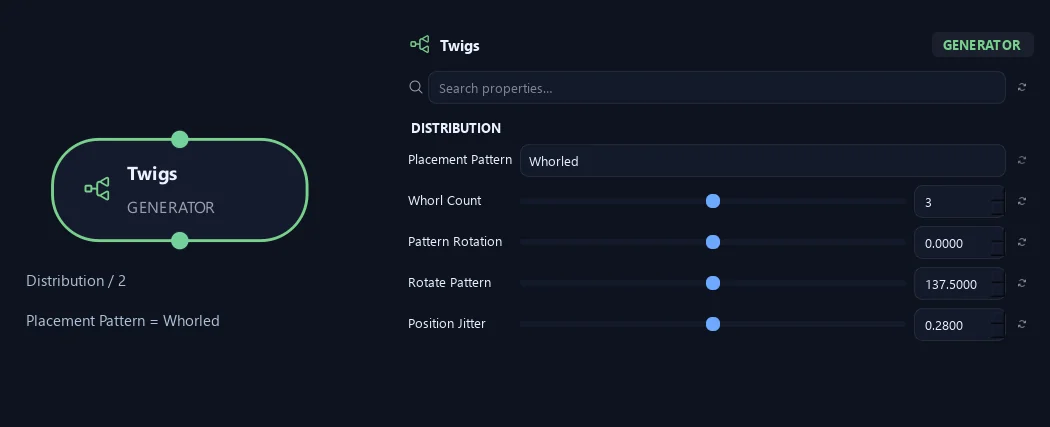
- Placement Pattern
Random distributes freely. Parallel pairs a total child count. Alternating switches sides along the parent. Opposite creates two children per site. Whorled creates a ring of children per site.
- Whorl Count
Sets children per site in Whorled mode. Opposite always uses two.
Available when Placement Pattern is Whorled.
- Pattern Rotation
Rotate the arrangement around each current local parent tangent before world-space Up / Down, Up Influence and Shape Sag. Rotate Pattern controls successive sites.
- Rotate Pattern
Rotates each successive site around the parent. With Opposite, zero aligns pairs and 90 degrees crosses each pair over the previous one.
- Position Jitter
Loosens spacing along the parent while keeping paired sites together.
Orientation (1)
Shown example: Placement Pattern = Opposite.
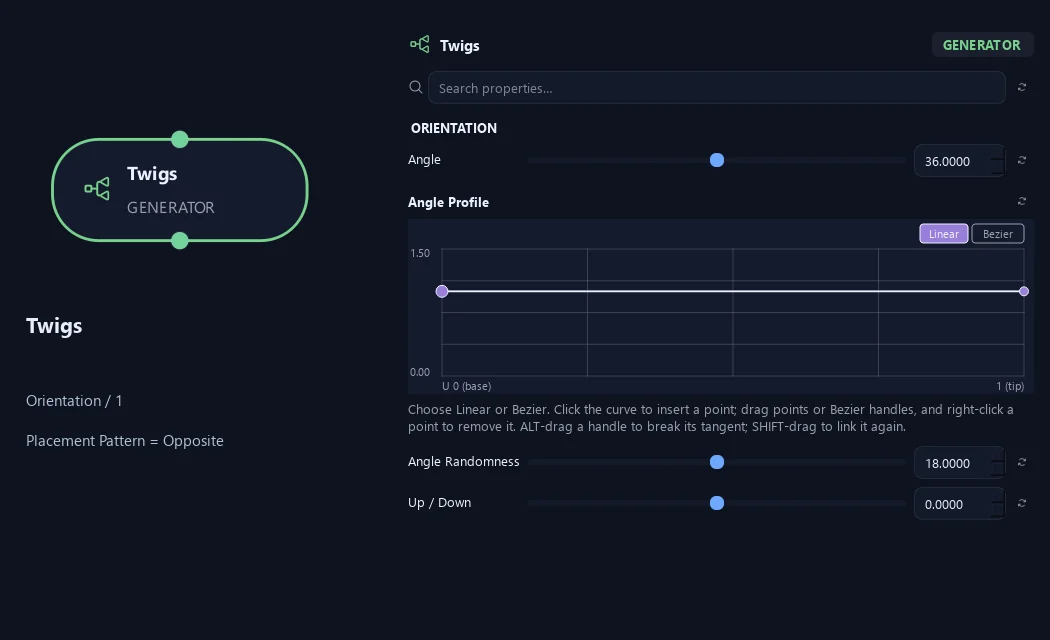
- Angle
Sets the angle away from the parent direction. Small values follow it; larger values open the growth outward.
- Angle Profile
Multiplies Angle by attachment position on the parent: left is base and right is tip. One keeps the angle, lower values close it and higher values open it.
- Angle Randomness
Varies the angle between branches or leaves. Zero keeps it consistent.
- Up / Down
Opposite only: add world elevation in degrees to both children after Angle and Pattern Rotation. Positive lifts, negative lowers; stops at vertical. A flat 180-degree pair at +10 has 160 degrees above / 200 below; -20 gives 220 above / 140 below. Up Influence and Shape Sag deform the result afterward.
Available when Placement Pattern is Opposite.
Orientation (2)
Shown example: Placement Pattern = Opposite.
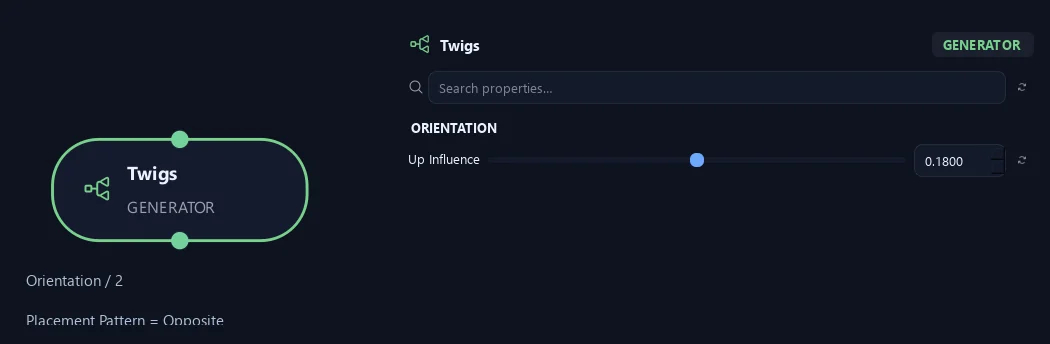
- Up Influence
Bias growth toward world +Y, independent of Pattern Rotation. Negative values bias toward -Y. Surface attachments bend along the path; embedded attachments adjust the initial growth direction.
Branch Attachment
Shown example: Surface Attachment = On.
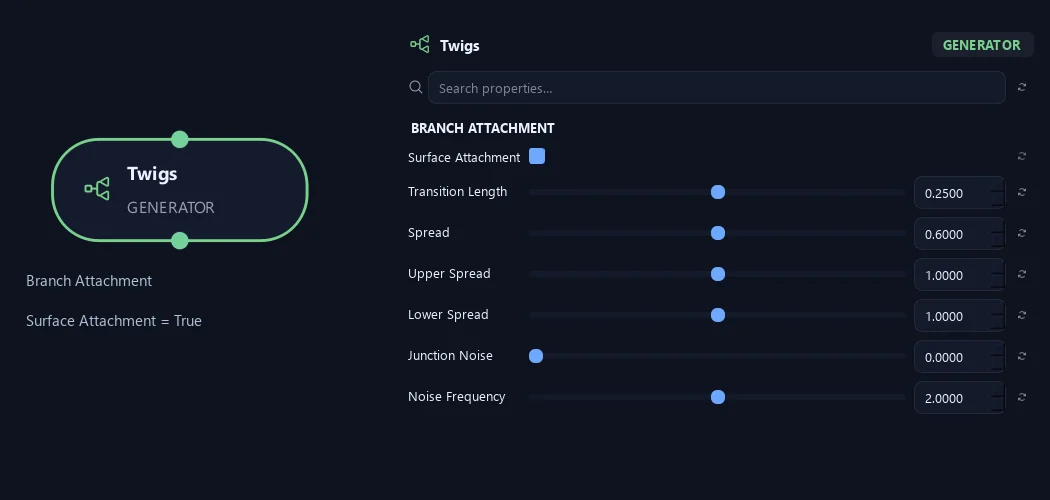
- Surface Attachment
Grow from the chosen parent surface position and fit the collar to its mesh using the existing Resolution rings.
- Transition Length
Maximum fraction of the visible branch used for the collar, limited by local branch thickness. Uses existing rings; increase Resolution for more collar detail.
Available when Surface Attachment is On.
- Spread
Expand the attachment footprint on the parent surface.
Available when Surface Attachment is On.
- Upper Spread
Scales the attachment footprint along the parent toward its tip. Use with Spread and Lower Spread to shape an asymmetric collar.
Available when Surface Attachment is On.
- Lower Spread
Scales the attachment footprint along the parent toward its base. The transition uses the existing mesh rings.
Available when Surface Attachment is On.
- Junction Noise
Seeded irregularity around the attachment footprint. Fades out into the branch.
Available when Surface Attachment is On.
- Noise Frequency
Sets how often the irregular junction pattern varies around the attachment. Increase Junction Noise first to make this variation visible.
Available when Surface Attachment is On.
What is ZenGrove used for?
The ZenGrove 1.0.0 reference: 52 nodes, 907 settings and short WebM demos. Explore Look At asset orientation, GameDynamics, joint previews, skeletal export and per-leaf random vertex colors. Requires AO.Hub 1.6.6 or later.
Which host application does ZenGrove support?
ZenGrove is built for Autodesk Maya and is distributed through AO Studio Tools.
Where can I download ZenGrove?
Download the current AO Studio Tools package from https://aostudio.tools/getthetools.html and install it through AO.Hub.